The wrong system quietly drains your water bill and your yields. Here’s where drip wins, where sprinklers make sense, and how your crop, soil, and water source should drive the decision.
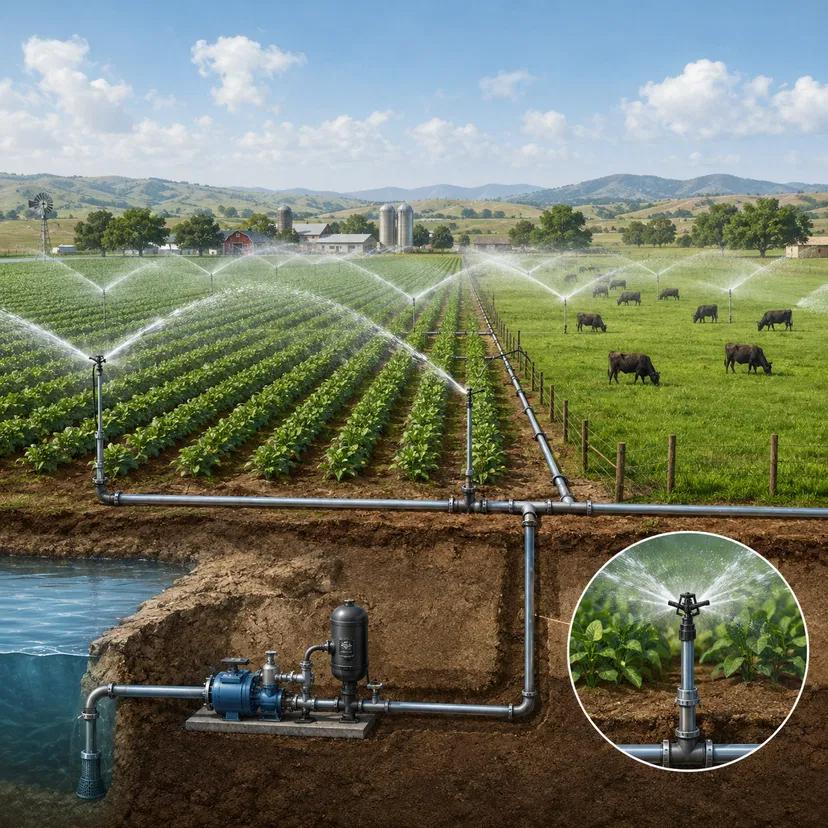
Irrigation isn’t a one-time purchase — it’s a decision you pay for every single day of the growing season. Every gallon that evaporates before it reaches the root zone, every hour a pump runs harder than it needs to, and every stressed plant that yields below potential traces back to system choice. And too often, that choice is made by default: farmers install what their neighbors have, or what the local dealer sells, rather than what their land actually demands.
Where Drip Wins
Drip irrigation delivers water slowly and directly to the root zone, and that precision pays dividends:
- Water efficiency. Drip systems run at 90–95% application efficiency, compared to roughly 65–80% for well-designed sprinklers — and far less in wind or extreme heat. In water-scarce regions, that gap is the whole ballgame.
- Lower disease and weed pressure. Because leaves stay dry and the soil surface between rows stays dry, fungal disease drops and weeds have less room to establish.
- Fertigation. Feeding crops through the drip line puts nutrients exactly where roots are, cutting fertilizer waste.
- Terrain tolerance. Drip works on slopes and uneven ground where sprinkler uniformity falls apart.
The trade-offs: drip carries higher upfront costs per acre, emitters clog without good filtration, and drip tape is a recurring expense.
Where Sprinklers Make Sense
Sprinklers aren’t obsolete — for many operations they’re simply the right tool:
- Germination and establishment. Broadcasting water mimics rainfall, giving uniform emergence to direct-seeded crops that drip simply can’t wet evenly.
- Close-growing crops. Alfalfa, pasture, small grains, and dense plantings don’t align with drip line spacing — sprinklers cover the whole field economically, especially with center pivots on larger acreage.
- Dirty water. Surface and canal water with sediment will clog drip emitters; sprinklers shrug it off.
- Frost protection and crop cooling. Overhead sprinkling is one of the few reliable tools for protecting blossoms from frost or cooling heat-sensitive crops.
- Salt management. Sprinklers leach accumulated salts from the soil profile, where drip can concentrate them at the edges of the wetting zone.
Let Your Crop, Soil, and Water Decide
Crop. High-value, widely spaced crops — tomatoes, melons, strawberries, orchards, vineyards — reward drip’s precision. Dense, lower-value stands favor sprinklers. And many growers wisely use both: sprinklers to germinate, drip to finish the season.
Soil. Sandy soils drain fast, so drip’s frequent, low-volume applications keep moisture in the root zone instead of pushing it past it. Heavy clays absorb slowly, so high sprinkler application rates can trigger runoff — though drip’s narrow wetting pattern in clay is worth testing on your ground before committing.
Water source. If water is scarce, metered, or expensive, drip’s efficiency usually pays back its higher cost within a few seasons. If your water is abundant, cheap, and sediment-laden, sprinkler economics improve dramatically. And remember pressure: drip can run on gravity and low pressure, while sprinklers — especially traveling guns — demand energy-hungry pumping.
The Bottom Line
There’s no universally superior system, only a better fit for your conditions. Map your crops, test your soil’s infiltration, and audit your water source and pressure before you spend a dollar on hardware. And if you’re still unsure, run a side-by-side trial on a few acres. The yield monitor and the water bill will tell you more than any sales brochure ever will.