
We ran the numbers on seepage losses versus lining costs — and the break-even point comes sooner than most farmers expect.
A leaking dam doesn’t send an invoice. It just quietly drains your water security underground, where you can’t see it, while you budget carefully for seed, feed, and fuel. But seepage is a cost like any other — and once you put a tape measure and a dollar figure on it, lining stops looking like an expense and starts looking like one of the best deals on the farm.
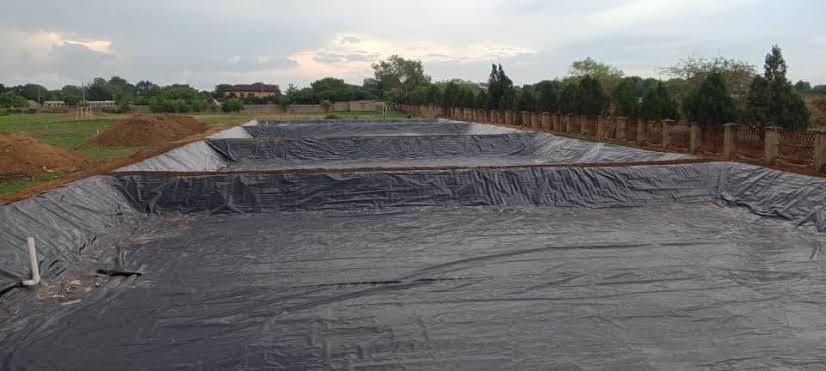
Step One: Find Your Real Seepage Rate
Don’t guess — measure. Drive a stake into the dam floor, mark the water level, and record the drop every day for two weeks. Then subtract evaporation, which you can measure for free with a straight-sided bucket of water next to the dam marked at the same time.
What’s left is seepage, and the soil tells the story:
- Sand or gravel: 10–20+ mm/day — the dam never really holds water
- Sandy loam: 4–8 mm/day — fills, then drains within weeks
- Loam: 2–4 mm/day — noticeable losses over a season
- Clay loam or clay: under 2 mm/day — usually no lining needed at all
For perspective: a dam seeping 6 mm/day is losing water at roughly the rate a crop drinks it.
The Math That Decides It
Seepage losses and lining costs are both driven by surface area, which makes the comparison beautifully simple:
Payback (seasons) = lining cost per m² ÷ (seepage rate × days the dam holds water × value per m³ of water)
The worked example, using realistic mid-range figures — 6 mm/day seepage, 240 days of water in storage, dry-season water worth $3/m³ (typical for horticulture, trucked water, or drought-year pumping):
- Annual loss per m²: 0.006 m × 240 days × $3 = $4.32/m²
- Installed liner cost: ~$9/m²
- Payback: just over two seasons.
For a typical 1,500 m² dam, that’s roughly $6,500 worth of water lost every year against a $13,500 liner — and with a quality HDPE liner lasting 20+ years, you’re looking at over $85 of water saved per m² on a $9 investment.
The same sensitivity at different seepage rates:
| Soil | Seepage | Payback at $3/m³ water |
|---|---|---|
| Sand | 12 mm/day | ~1 season |
| Sandy loam | 6 mm/day | ~2 seasons |
| Loam | 3 mm/day | ~4 seasons |
| Clay loam | 1.5 mm/day | 8+ seasons — don’t line |
A useful rule of thumb: every 1 mm/day of seepage costs about $0.72 per m² per season at $3/m³ water. Your local prices will differ — but the method won’t.
Where the Value Comes From
The $3/m³ figure isn’t arbitrary — it’s the return water generates when it actually reaches July, August, and September:
- Dry-season production. 1,000 m³ of stored water sustains roughly half a hectare of drip-irrigated vegetables through the critical window. Gross margins of $2–5 per m³ of water are normal in horticulture.
- Avoided replacement. Trucked water runs $2–5/m³ almost everywhere; deep borehole pumping is cheaper but still costs energy, wear, and drawdown.
- Drought insurance. In a dry year, that stored water isn’t worth $3/m³ — it’s the difference between a crop and a write-off.
What Lining Actually Costs
- HDPE geomembrane (0.75–1.5 mm): the workhorse. $8–12/m² installed with geotextile underlay, subgrade prep, and anchor trench. 20–30+ year life.
- EPDM rubber: $10–15/m², extremely puncture-resistant, forgiving for small dams and DIY installs.
- GCL (bentonite liner): $8–15/m², self-sealing around small punctures, good where rocky ground makes membrane damage a risk.
- Compacted clay: the budget option — if a clay source exists within hauling distance.
The Mistakes That Erase the Payback
A liner only pays if it holds water, and most liner failures are installation failures:
- Skipping the geotextile underlay on rocky subgrade — the number one cause of punctures.
- Lining over roots and stumps. Roots hunt for seams and find them.
- Anchor trench too shallow. Wind uplift pulls the liner out from the edges. Go 300–600 mm deep.
- Fixing the liner before the outlet pipe. A leaking outlet drains the dam regardless of what the floor is doing.
- Unfenced stock. Cattle hooves will find every weakness. Fence it or cover the base with a protective soil layer.
When Lining Doesn’t Pay
Honesty time: on clay loam seeping under 2 mm/day, the payback stretches past eight seasons — spend the money elsewhere. And if evaporation, not seepage, is your main loss (in hot, windy country it can hit 5–8 mm/day), a liner does nothing for you — windbreaks, floating covers, or a deeper dam profile are the answer. Finally, if the dam itself is failing — cracked walls, broken spillway — rebuild it before you line it. A $13,500 liner on a failing structure is money poured into the ground.
The Bottom Line
Two weeks with a stake, a tape measure, and a bucket will tell you your seepage rate. Ten minutes of arithmetic will tell you your payback. On sandy ground with water that carries real value, the liner typically clears its cost in the second season — then spends the next twenty years delivering the cheapest water you’ll ever buy. You’re not spending $13,500 on plastic. You’re prepaying, at a steep discount, for two decades of dry seasons that no longer worry you.