
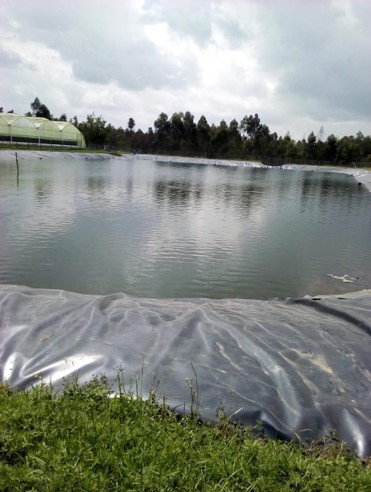
Fingerling counts, feeding rates, and harvest timing — a plain-numbers guide for your first production cycle.
Most first fish ponds don’t fail from laziness. They fail from optimism — stocking more fingerlings than the pond can carry to market size. Overstocking sets off a chain reaction: crowded fish, oxygen crashes at dawn, wasted feed, stunted growth, and a harvest that doesn’t cover the feed bill. The fix isn’t experience; it’s arithmetic. Run these numbers before the fingerling truck arrives.
Start Backwards: From the Pond’s Ceiling
The first number you need isn’t how many fish you want — it’s how many kilograms your pond can carry. A static earthen pond without aeration supports roughly 1 kg of fish per m² (about 10 tonnes per hectare). That ceiling is set by dissolved oxygen, not by water volume, and every other decision is calculated backwards from it.
The Stocking Math
- Pick your market size first. Tilapia typically sell at 250–300 g; catfish at 500 g to 1 kg.
- Divide, don’t dream. With a 1 kg/m² ceiling and a 300 g target, the ceiling allows about 3 fish/m² at 100% survival — and survival is never 100%.
- Safe first-cycle densities: 2–3 tilapia per m². Catfish tolerate 5–10 per m², but only with aeration or daily water exchange.
- Budget for mortality. Expect 10–20% losses; 85–90% survival is a strong first result.
- Buy bigger fingerlings. A 20–30 g fingerling costs more than a 5 g one, but survives better and cuts weeks off the cycle.
- Stock all-male tilapia. Mixed-sex ponds fill with fry by month four, and your 2 fish/m² becomes ten — stunting everything.
Feeding: The Number That Runs Your Budget
Feed is 50–70% of your operating cost, so feed by the scale, not by the sack.
- Feed a percentage of biomass: 3–5% of body weight daily for juveniles, dropping to 2–3% mid-cycle and 1.5–2% near harvest.
- Split it into 2–3 feedings a day. Floating pellets should be gone in about 15 minutes — if not, cut the ration.
- Sample every two weeks. Seine a sample, weigh 30–50 fish, recalculate total biomass, and adjust the ration. Guessing wrong in either direction costs money: underfed fish grow slowly, overfed fish waste feed and pollute the pond.
- Know your FCR. A feed conversion ratio of 1.6–1.8 (kg of feed per kg of gain) is the target. Hitting 2.0 in your first cycle is a lesson, not a disaster.
Harvest: Timing by Growth Math, Not Patience
At optimal temperatures (26–30 °C), tilapia grow 1–2 g per day — so a 25 g fingerling reaches 300 g in about 5–6 months. Catfish hit 500 g to 1 kg in 4–6 months.
Two triggers should end your cycle, whichever comes first:
- Fish reach market size. Every week past it, feed cost per kg of gain rises while prices don’t.
- Biomass approaches ~80% of the pond’s ceiling. Near capacity, oxygen crashes and disease stop being risks and become schedules.
Partial harvesting at 200–250 g is a legitimate strategy: it frees capacity for the remaining fish and brings cash in early.
The Guardrail Numbers
- Dissolved oxygen above 4 mg/L. Dawn is the danger hour. Fish gulping at the surface is an emergency, not a phase.
- Below 22 °C, tilapia feeding and growth slow sharply. Match the ration to the thermometer.
- Watch the feed response daily. Fish refusing feed is often your first — and earliest — warning of a water problem.
Your First Cycle on One Page
| 500 m² tilapia pond | Number |
|---|---|
| Fingerlings stocked | 1,000 (2 per m²) at ~25 g |
| Expected survival | ~90% → 900 fish |
| Harvest weight | 300 g average → ~270 kg |
| Feed required | ~460 kg (FCR 1.7) |
| Time to harvest | 5–6 months |
Note that 270 kg is barely half the pond’s ceiling — that’s deliberate. Your first cycle is partly tuition. Once you know how your pond behaves at dawn in month five, you can push density toward 3 per m² with confidence.
The Bottom Line
Stock under the ceiling, feed by the scale, and harvest by growth math. Hit those three numbers — 85% survival, FCR under 2.0, harvest within 6 months — and your first cycle will teach you something profitable. Miss them, and the pond will teach you anyway, just at a higher price.